
. Jeep identity for Lunar and Mars rovers.
.
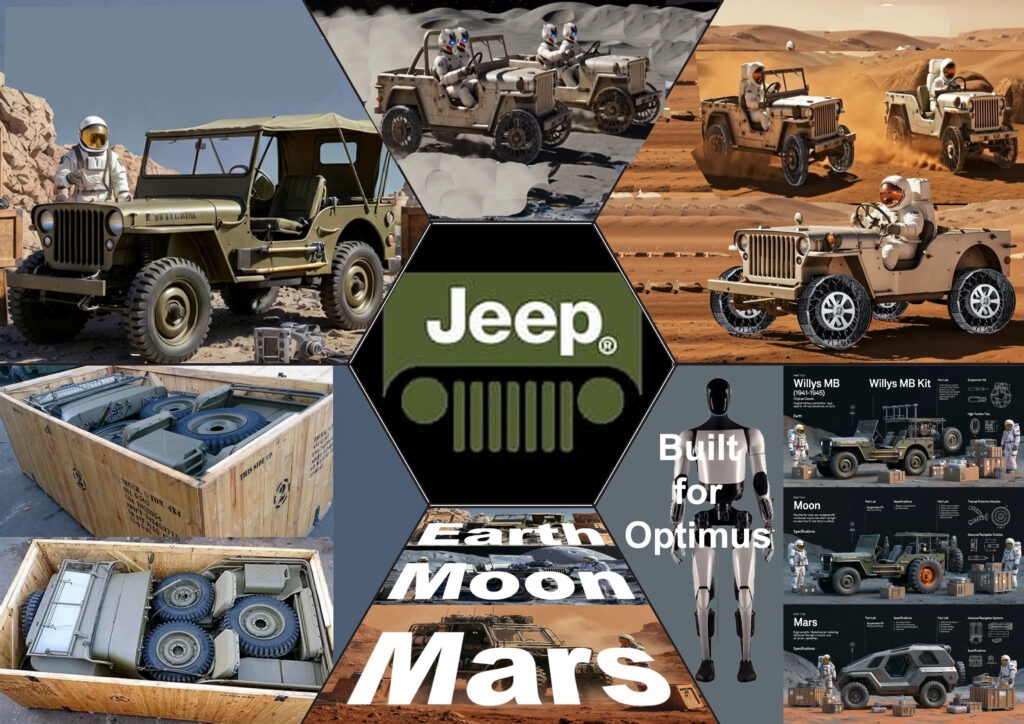
The Jeep is such an iconic USA brand with great history that I think it deserves adaptions of Lunar rovers to its iconic look and brand identity, it would work well on Earth viewed video footage from Moon or Mars, ‘Always nice to see a friendly face’ could be a saying for the space faring Jeep brand.
.
.
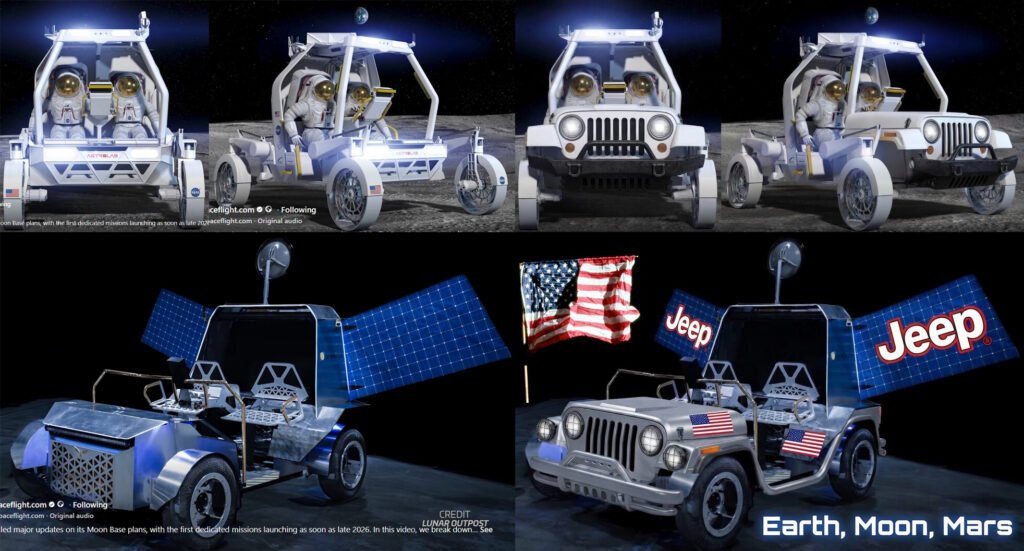
Jeep: Earth, Moon, Mars and beyond.. The Jeep brand remains one of the most instantly recognizable symbols of American ingenuity, toughness, and freedom. From its origins as the Willys MB in World War II to its long civilian history, the name “Jeep” carries an emotional weight few vehicle brands can match. Extending that identity to Lunar and Mars rovers would give future surface vehicles an immediate sense of familiarity and trust for audiences on Earth. Seeing a familiar silhouette and the classic seven-slot grille on another world would reinforce the idea that American engineering continues to push outward, making the distant frontier feel more connected to home.
.
.
Returning the Brand to Full American Ownership
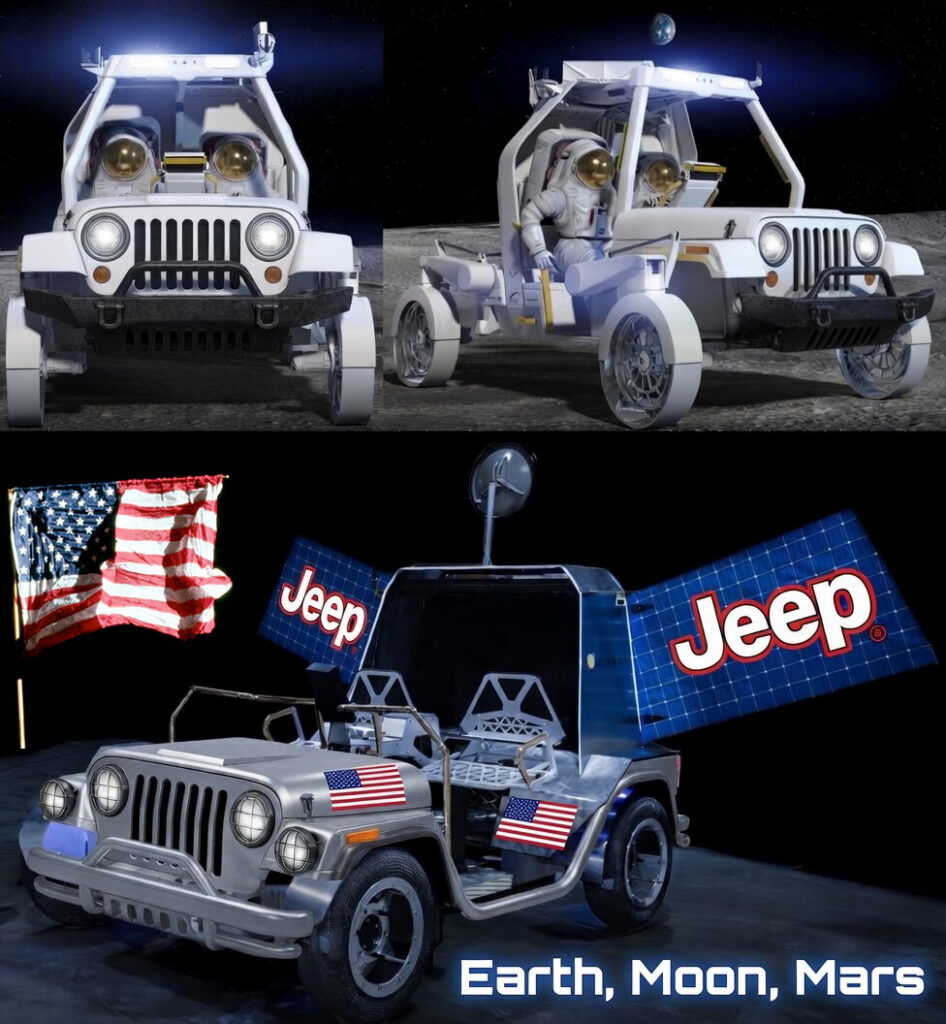
While the Jeep name is currently under international corporate ownership, there is a strong case for restoring full American control of the brand as space exploration accelerates. A revitalized, independently American Jeep could focus more directly on next-generation mobility, including extreme-environment vehicles designed for the Moon and Mars. Bringing the brand fully back under U.S. ownership would allow decisions about design, technology partnerships, and national-priority projects to be made with American interests at the center. In the context of a renewed Space Race, an American-owned Jeep would stand as both a practical manufacturer and a cultural symbol of national capability.
.
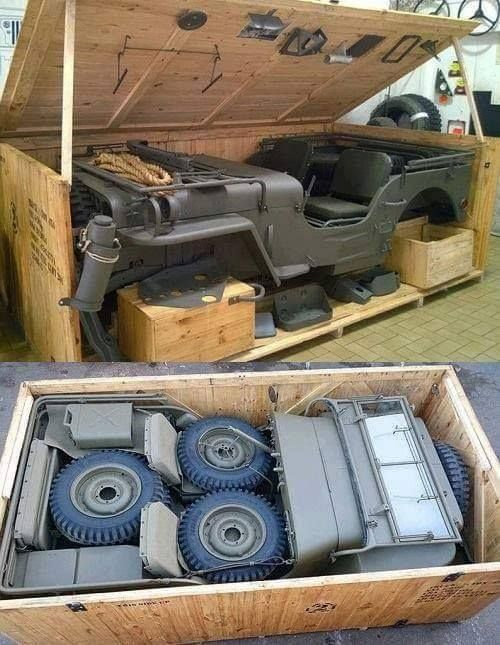
The image below shows how the Willys Jeep left the factory in boxed kit format, a stackable efficient packaging system, a project that could be updated for modern Lunar rovers transport to the Moon.
.
Product and Price Advantages
Jeep’s long history of producing durable, adaptable vehicles gives it a natural foundation for developing Lunar and Mars rovers that are both capable and cost-effective. By adapting proven design principles, modular construction, ease of field maintenance, and rugged simplicity, future Jeep-branded surface vehicles could be engineered for efficient production and transport. Standardized, container-friendly packaging (echoing the original boxed wartime kits) would reduce logistics costs, while a focus on robust but non-over-engineered systems could keep unit prices more competitive than purely bespoke space vehicles. The result would be practical, scalable rovers that deliver high utility at a lower overall cost, supporting both government and commercial surface operations.
.
Because when the going gets tough, the tough get Jeep…
Historian Charles K. Hyde wrote: “In many respects, the jeep became the iconic vehicle of World War II, with an almost mythological reputation of toughness, durability, and versatility.” It became the workhorse of the American military, replacing horses, other draft animals, and motorcycles in every role, from messaging and cavalry units to supply trains. In addition, improvised field modifications made the jeep capable of just about any other function soldiers could think of. Jeeps were adopted into the militaries of countries all over the world, so much so that they became the most widely used and most recognizable type of military vehicle in history.
Dwight D. Eisenhower, the Supreme Commander of the Allied Expeditionary Force in Europe in World War II, wrote in his memoirs that most senior officers regarded it as one of the five pieces of equipment most vital to success in Africa and Europe. General George Marshall, Chief of Staff of the US Army during the war, called the vehicle “America’s greatest contribution to modern warfare. In 1991, the MB Jeep was designated an “International Historic Mechanical Engineering Landmark” by the American Society of Mechanical Engineers.
.
After WWII, the original jeep continued to serve, in the Korean War and other conflicts, until it was updated in the form of the M38 Willys MC and M38A1 Willys MD (in 1949 and 1952 respectively), and received a complete redesign by Ford in the form of the 1960-introduced M151 jeep. Its influence, however, was much greater than that — manufacturers worldwide began building jeeps and similar designs, either under license or not — at first primarily for military purposes, but later also for the civilian market. Willys turned the MB into the civilian CJ Jeeps, starting with the CJ-2A in 1945, producing the world’s first mass-produced civilian four-wheel drive. The “Jeep” name was trademarked and grew into a successful and highly valued brand. For more go to Willys MB – Wikipedia
.